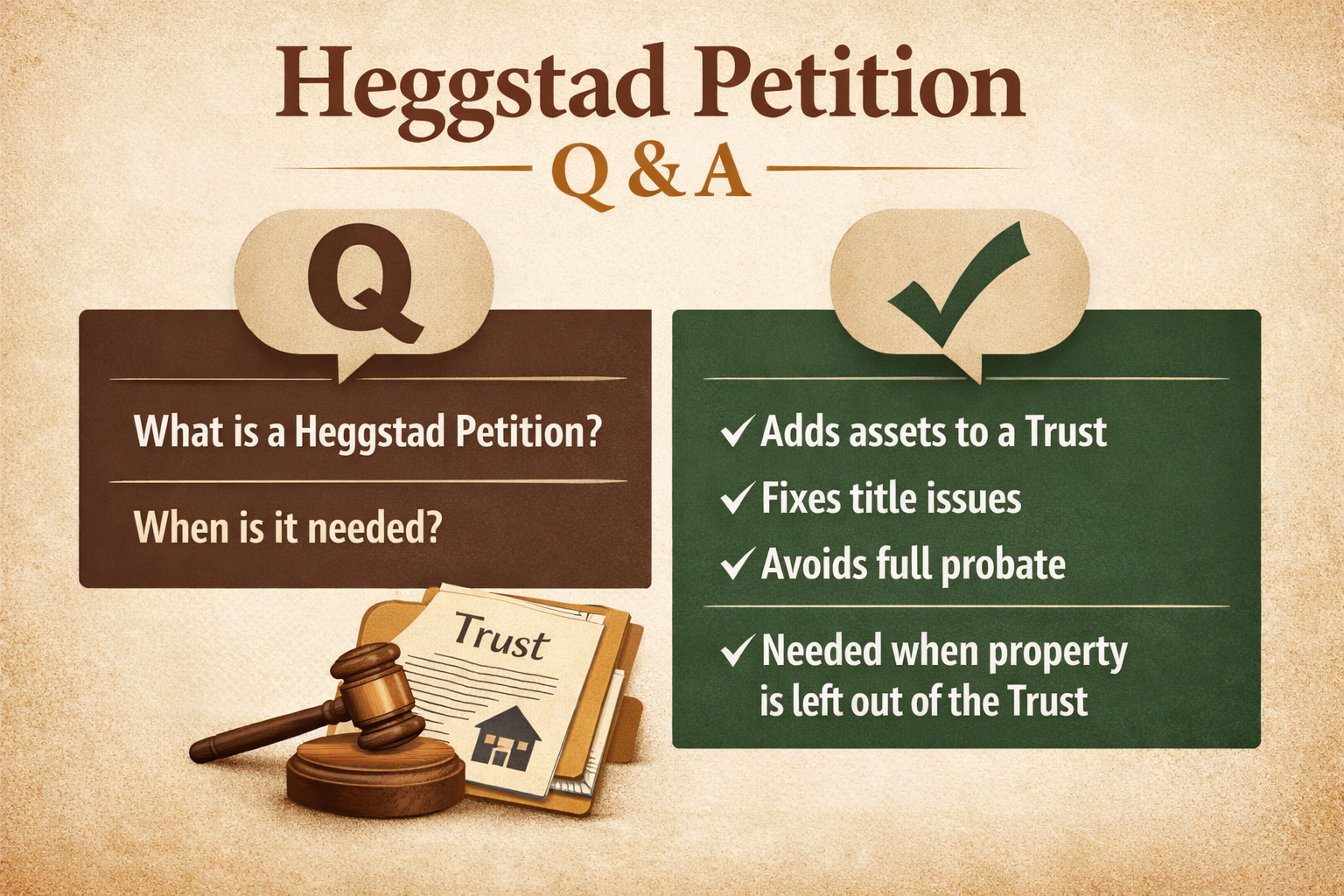
A Heggstad Petition is a court procedure used in California to confirm that real property belongs to a trust — even if the title was never formally transferred into the trust before death Heggstad_Petition.
It is filed under California Probate Code Section 17200 and asks the Superior Court to declare the property a trust asset.
This is one of the most searched probate topics on Reddit and estate planning forums because many families discover, after someone passes away, that the house was never deeded into the trust.
When Do You Need a Heggstad Petition?
A Heggstad Petition is used in California when an asset was intended to be in a revocable living trust but was never formally transferred into the trust before death.
It is commonly used to avoid full probate when:
• Real estate was never deeded into the trust
• A bank account was not retitled
• An asset was listed on Schedule A but not properly transferred
The petition asks the probate court to confirm that the asset belongs to the trust based on clear evidence of the decedent’s intent.
How It Works
The successor trustee files a petition under Probate Code §850 and provides:
• The trust document
• Schedule of Assets (if available)
• The recorded deed or account records
• Proof of death
• Evidence showing intent to include the asset in the trust
If the court grants the petition, the asset is treated as a trust asset — often avoiding full probate.
What Happens
The house becomes part of the probate estate, not the trust.
Court supervision is required to retitle or sell it.
A pour-over will does not avoid probate — it just directs the asset into the trust after probate.
Possible Options
File for probate to transfer title to heirs or into the trust.
In California, a Heggstad/Section 850 petition may work if there is clear proof the deceased intended the house to be in the trust.
If a signed but unrecorded deed exists, it may be recorded.
If the estate qualifies as small, simplified procedures may apply.
Key Points
Act quickly and consult a probate attorney.
Selling during probate may require court approval.
No will = property passes under intestate law.
Probate can take months and cost several thousand dollars.
In short: if the deed was never transferred to the trust, probate is usually required unless a limited exception applies.
If a property left out of trust what happens?
If a property was left out of a trust before death, it does not automatically transfer under the trust. Instead, it typically must go through probate.
Probate is a court-supervised process that validates the will (if one exists), pays debts, and distributes assets. In California, full probate can take a year or more, is public record, and involves statutory attorney fees that are often 4–7% of the estate’s gross value.
Small estate procedures may apply to low-value assets, but real estate in high-value markets like Los Angeles or Santa Monica rarely qualifies due to property values.
There are potential ways to avoid full probate. In California, a Heggstad Petition (Probate Code §850) may allow the court to confirm the property as a trust asset if there is clear evidence the decedent intended it to be in the trust. If successful, this can transfer the property without full probate.
If there is no will, intestate succession laws determine who inherits, typically prioritizing spouse and children.
Because title and timing are critical, especially if the property will be sold, it is important to have a probate attorney review the trust documents, deed history, and available remedies promptly.
forgot to fund trust California
House Still in a Deceased Parent’s Name - What Happens Next?
What you do depends on two things: whether there is a trust and how the deed is titled.
First Confirm the Basics
• Did your parent have a living trust or only a will?
• How is the property titled on the last recorded deed?
• Is there a surviving spouse or co-owner on title?
These answers determine whether the property transfers through trust administration, probate, or a simple title update.
If There Is a Living Trust
If the deed already shows the trust, the successor trustee can usually transfer or sell the home by recording:
• Affidavit of Death of Trustee
• New grant deed
• Change of ownership report
If the deed is still in the parent’s personal name but the trust shows the house was intended to be included, the trustee may file a Heggstad petition to have the court confirm it as a trust asset and avoid full probate.
This often happens when a trust was created but the deed was never transferred.
If There Is No Trust
If the home is only in the deceased parent’s name and no valid trust controls it, probate is usually required to transfer title, unless the estate qualifies for a small-estate procedure.
The court appoints a personal representative who has authority to transfer or sell the property.
This process is slower and more formal than trust administration or a Heggstad petition.
California Practical Issues
• Transfers to children may qualify for Prop 19 tax limits if requirements are met.
• Mortgage payments must continue; inheritance alone typically does not trigger loan acceleration under federal law.
When a Heggstad Petition Is Typically Needed
A Heggstad petition is commonly used when:
• A living trust exists
• The trust shows the house was intended to be included
• But the deed still shows the parent individually at death
The court can confirm the property as a trust asset — helping avoid full probate.
What Happens If a House Is Still in a Deceased Person’s Name but There Is a Trust?
A Heggstad Petition may be required when:
• The person creating the trust forgot to transfer title
• The person died before completing the transfer
• The deed was prepared incorrectly
• Property was removed from the trust for refinancing and never transferred back Heggstad_Petition
This situation is more common than most people realize.
Does a Heggstad Petition Avoid Probate?
One of the biggest Reddit questions:
can a heggstad petition avoid probate in california
Yes, if granted by the court, it allows the property to be treated as a trust asset, which can prevent a full probate proceeding.
A Heggstad Petition typically takes 60–90 days, compared to 7–10 months for full probate Heggstad_Petition.
That timeline difference is significant for families trying to sell real estate quickly.
How Long Does a Heggstad Petition Take in Los Angeles?
The process includes:
• Filing a verified petition in Superior Court
• Providing 30 days’ notice to interested parties
• Court hearing and judicial review Heggstad_Petition
In most cases, the process can be completed in approximately 60 to 90 days Heggstad_Petition.
In Los Angeles County, timelines may vary depending on court backlog.
What Evidence Is Required for a Heggstad Petition?
You must show clear intent that the deceased meant for the property to be part of the trust, even though title was never transferred.
Core Documents
Trust document (and amendments) – proves the trust exists.
Schedule of Assets – must specifically list the property.
Death certificate – confirms death.
Recorded deed – shows the decedent owned the property.
Helpful Supporting Evidence
Pour-over will (a will that directs any assets left outside the trust at death to be transferred into the trust after probate)
Written statements, emails, or notes showing intent
Mortgage or insurance documents referencing the trust
Key Point
The strongest evidence is when the property is specifically listed on the trust’s Schedule of Assets.
Can You Sell a House During a Heggstad Petition?
You generally cannot sell a property while a Heggstad Petition is pending. The court must first issue an order confirming the property as a trust asset before the trustee has clear authority to sell. Until that order is granted, title is clouded and escrow typically cannot close.
A Heggstad Petition usually takes about 60–90 days. If there is urgency, a probate court can appoint a special administrator to grant temporary authority to sell, sometimes within a couple of weeks. Full probate letters take longer and do not avoid probate.
Because timelines vary by county, especially in Los Angeles, a probate attorney should review the trust and deed immediately if a sale is pending.
What are title company requirements heggstad order?
Title companies require a certified copy of the court order confirming the property as a trust asset before closing Heggstad Petition.
Without that order, escrow typically cannot proceed.
This is critical for real estate agents handling trust sales.
Is a Heggstad Petition Expensive?
Compared to full probate, it is usually less expensive and faster.
However, legal fees vary depending on complexity and whether objections are filed.
Families often pursue this option because it is substantially shorter than traditional probate Heggstad_Petition.
What Happens If You Don’t File a Heggstad Petition?
If the property was never formally transferred and no petition is filed, the home may need to go through probate, even if a trust exists.
This surprises many families.
Trusts only avoid probate if assets are properly funded into them.
Why Is This Important for Real Estate Sellers in Los Angeles?
In high-value markets like Santa Monica and Los Angeles:
• Probate delays can impact timing
• Transfer tax thresholds (Measure ULA / Measure GS) may become relevant
• Buyers require clean title
If a property was intended to be in a trust but was not properly transferred, resolving title through a Heggstad Petition can prevent significant delay.
Conclusion
In California, a trust only avoids probate if the assets are properly funded into it. When real estate is left out, whether by oversight, refinancing, or an unrecorded deed — families often discover the problem at the worst possible time: after death, and sometimes while trying to sell.
A Heggstad Petition can be a powerful remedy. When granted, it allows the court to confirm that the property belongs to the trust, potentially avoiding full probate and saving months of delay and significant statutory fees.
However, timing matters. Title matters. Evidence matters.
In Los Angeles and Santa Monica, where property values are high and buyers expect clean title, unresolved trust funding issues can derail escrow, delay sales, and create unnecessary stress for heirs.
If you’ve inherited property, are administering a trust, or are preparing to sell a home that may not have been properly transferred into a trust, the first step is reviewing the deed history and trust documents immediately. Delays compound risk. And in real estate, time always matters.
Contact Us
If you are handling an inherited property in Los Angeles or Santa Monica and are unsure whether probate is required, I can help you navigate the real estate side while your probate attorney handles the court process.
I work closely with trustees, executors, probate attorneys, and title companies to ensure properties are positioned correctly, priced strategically, and sold efficiently once authority is confirmed.
Inherited properties require precision, timing, and experience.
If you’re considering selling a trust or inherited home, call me directly to discuss your situation confidentially.