Santa Monica Real Estate Measure GS Mansion Tax
What is Measure GS, Santa Monica Real Estate Transfer Tax?
Measure GS, the "Funding for Homelessness Prevention, Affordable Housing, and Schools" initiative, is a 5.6% transfer tax on property sales over $8 million in Santa Monica. Approved in 2022, it aims to fund homelessness prevention, affordable housing, and local schools.
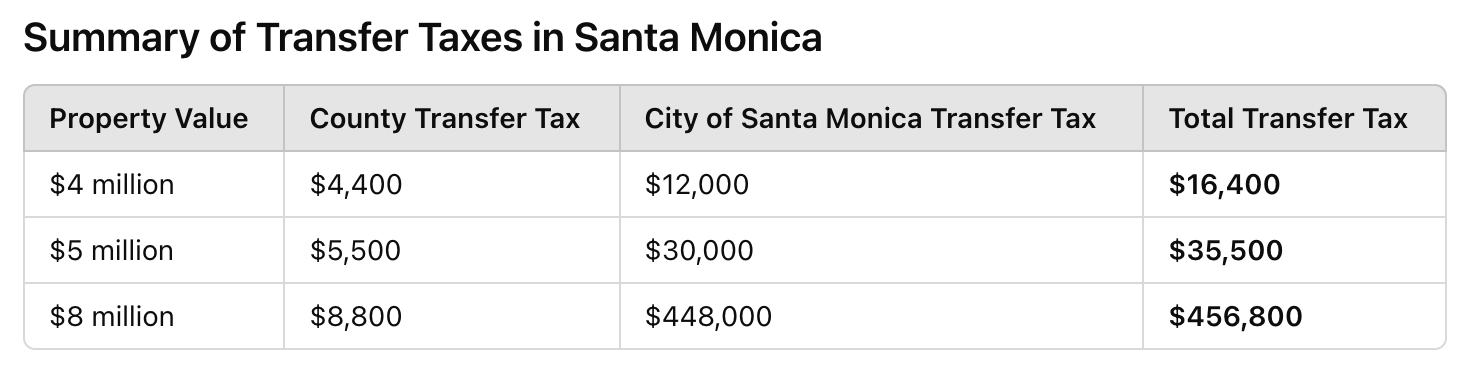
Santa Monica transfer Tax calculator, Santa Monica Measure GS-Mansion Tax, Santa Monica City transfer fee explained.
Transfer Taxes in Santa Monica and Los Angeles County
Los Angeles County Transfer Tax
When you sell property anywhere in Los Angeles County, there is a county transfer tax. The fee is $0.55 for every $500 of value transferred. This is a standard rate that applies across the county.
Santa Monica City Transfer Tax
If your property is in Santa Monica, the city charges an additional transfer tax on top of the county fee. The amount depends on the value of the property:
Sales under $5 million: $3.00 for every $1,000 of the property value (0.3%).
Sales between $5 million and $7,999,999: $6.00 for every $1,000 of the property value (0.6%).
Sales at $8 million or more: $56.00 for every $1,000 of the property value (5.6%). This higher tax rate, known as Measure GS, took effect on March 1, 2023 after being approved by voters in November 2022.
Santa Monica About Measure GS, Also known as Santa Monica Mansion Tax:
Who Pays the Tax?
Measure GS applies only to sellers of properties valued at $8 million or more. It is not a yearly property tax but a one-time transfer tax of 5.6% charged at the time of sale.
What Types of Properties Are Covered?
It applies to all types of real estate in Santa Monica, including:
Residential homes
Condominiums
Apartment buildings
Commercial buildings
Land
If it is real property in Santa Monica and the sale price is $8 million or more, Measure GS applies.
Impact on Sales Since March 1, 2023
Measure GS went into effect on March 1, 2023, and the impact was immediate:
Residential sales over $8M: Dropped from 32 sales (March 2022–March 2023) to 15 sales (March 2023–March 2024). That is a 53% decrease.
Commercial and multi-unit sales over $8M: Fell from 18 sales to 5 sales in the same period. That is a 72% decrease.
Are There Exemptions?
Yes. Affordable housing projects, non-profit corporations, and community land trusts are not subject to this tax.
Effect on the Market and Local Economy
The higher transfer tax has discouraged large transactions in Santa Monica. This slowdown has had a ripple effect on related industries. Business is estimated to have dropped by about 60% for the many professionals who support real estate sales at this level — from contractors and electricians to realtors, loan officers, escrow officers, appraisers, stagers, and photographers.
Effect on Development
Developers are more cautious about starting luxury or multi-unit projects in Santa Monica. The added tax lowers profit margins and makes it harder to justify new construction.
For Homeowners
If your property value is close to the $8 million threshold, timing matters.
At $7,999,999, the tax is about $48,000 (0.6%).
At $8,000,000, the tax jumps to about $448,000 (5.6%).
That’s a $400,000 difference for just one extra dollar in price.
Santa Monica Measure GS proposal initiative: Proposal to Exclude Multifamily Sales
Former Santa Monica Mayor Pam O’Connor has proposed an initiative to exempt multi-family dwellings from the city’s transfer tax, aiming to get it on the fall ballot. Critics of this proposal present several concerns:
Loss of Funding: Opponents argue that this exemption would reduce the money available for the original goals of Measure GS, which include homelessness prevention, affordable housing, and support for public schools.
Ignoring Voters' Decision: Some believe that the proposed exemption undermines the decision made by voters who approved Measure GS back in 2022.
Benefiting Developers: Critics worry that the change could mainly benefit wealthy developers, potentially diverting resources away from social programs that help the community.
Premature Change: Many feel that it’s too soon to make changes to Measure GS, as the full impact of the measure has not yet been fully understood or evaluated.
Impact on Affordable Housing: Some, including Sue Himmelrich, former mayor of Santa Monica, who initially supported Measure GS, believe that this change could harm funding for affordable housing, making it harder for the city to address its housing needs.
Supporters of the proposed initiative to exempt multi-family dwellings from Santa Monica's transfer tax (Measure GS) present several key arguments to defend their position:
Encouraging Housing Development: Proponents believe that exempting multi-family dwellings from the transfer tax could incentivize more development, especially for much-needed multi-family housing. This could be a crucial step toward addressing housing shortages in Santa Monica, where the demand for housing has often outpaced supply.
Improving Financial Viability for Developers: By removing this tax burden, supporters argue that development projects, particularly those involving multi-family units, would become more financially viable. This could attract more developers to undertake new projects, potentially leading to an increase in the overall housing supply in the area.
Meeting State Housing Mandates: The exemption is also seen as a way to help Santa Monica achieve state-mandated housing production goals. California has set specific targets for cities to produce more housing, and reducing financial barriers like transfer taxes could support Santa Monica's efforts to comply with these requirements.
Stimulating Economic Activity: Supporters also highlight the potential economic benefits of the exemption. By encouraging new development, the initiative could boost activity in construction and related industries, creating jobs and fostering economic growth in the community.
Will the Ballot Initiative to Exempt Multi-Family Housing from the Transfer Tax Succeed?
The outcome of this legal challenge will determine if the measure makes it onto the ballot. So far, it has not.
Bottom Line
If you own property in Santa Monica, be it land, a commercial building, a multi-unit apartment complex, or a luxury home with stunning views, it’s important to understand the implications of the transfer tax when selling. Measure GS in Santa Monica has introduced a significant city transfer tax that can be a substantial financial consideration for properties with high equity gains. Specifically, if your equity gain falls between $7 million and $8 million, selling now could help you avoid paying close to half a million dollars in transfer fees.
Whether you’re considering selling a luxury home, multifamily building, or commercial property, understanding how these tax measures apply to your sale is critical for maximizing your returns.
Have questions about how Measure GS might affect your sale, or wondering what your property could be worth in today’s market? Let’s connect. Contact us today for a tailored analysis and a strategy to help you sell at the best price, minimizing tax impact and maximizing your investment. Don’t let uncertainty hold you back—reach out now and take the next step toward a successful sale in Santa Monica.