What’s Happening in LA Commercial Real Estate (Q4 2025 → 2026)
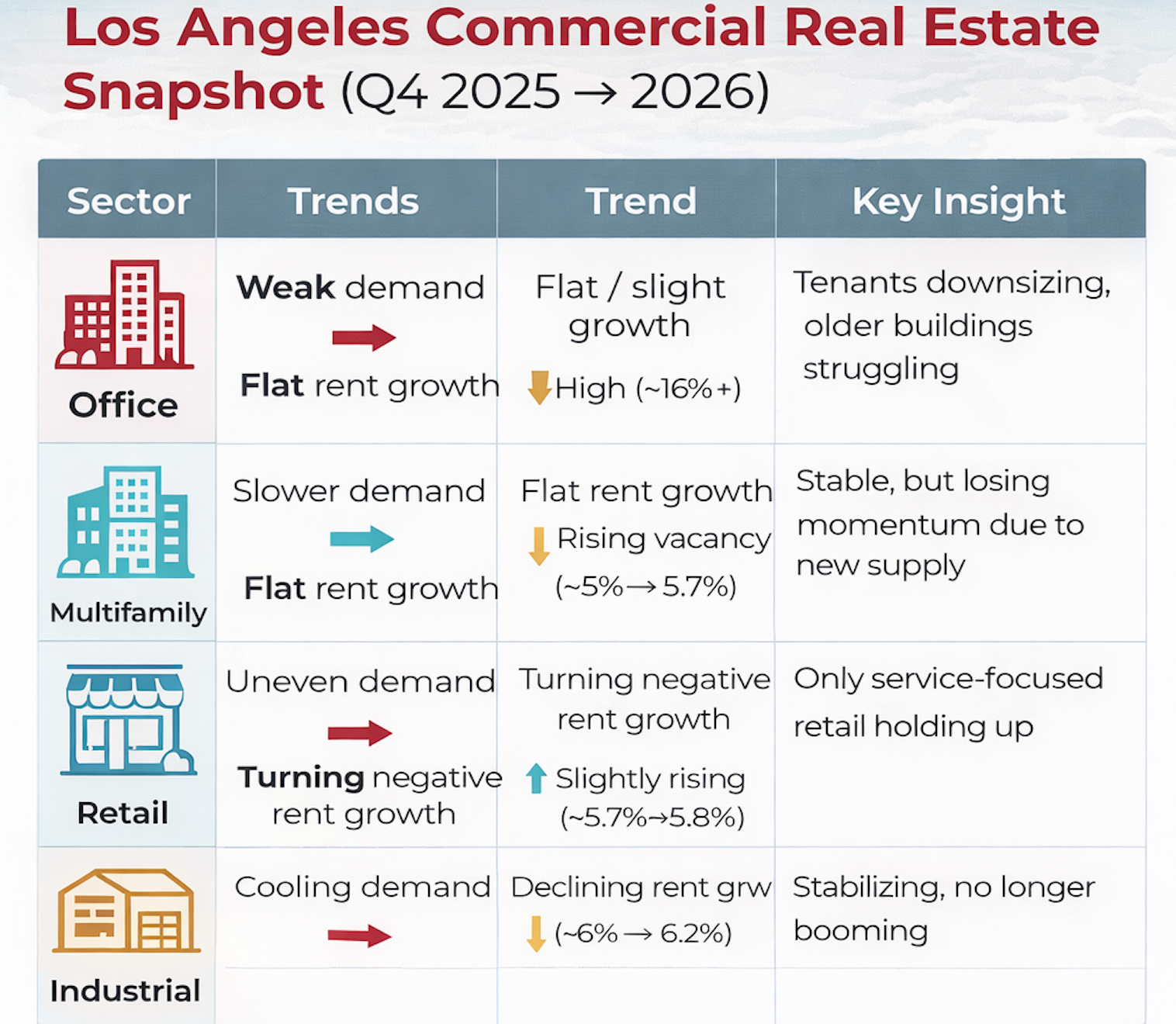
The Los Angeles commercial market is no longer a growth story. it’s a reset story.
Across office, multifamily, retail, and industrial, the data is telling one consistent narrative: Demand exists, but it’s selective, slower, and more price-sensitive.
Here’s the breakdown by the National Association of Realtors, NAR based on the latest data and confirmed market trends:
Office: High Vacancy, Selective Demand
Vacancy pushing 23%+ across Los Angeles
Leasing activity at multi-year lows
Tenants are downsizing, not expanding
Class A buildings attract demand while older assets struggle
Bottom line: Office isn’t dead—the market is shifting toward quality, well-located assets and away from obsolete, outdated buildings.
Multifamily: Stable, But Slowing
Vacancy rising toward ~5.7%–5.8%
Rent growth flattening or slightly negative
New supply putting pressure on rents and occupancy
Bottom line: Multifamily remains the most resilient asset class, but it’s no longer passive—performance now depends on pricing, tenant retention, and active management.
Retail: Quietly Fragile
Vacancy creeping up (~5.7%–5.8%)
Rent growth turning negative in some segments
Clear divide: service and grocery stable, discretionary retail weak
Bottom line: Retail works, but only for tenants that require a physical presence.
Industrial: Cooling After a Strong Run
Vacancy rising (~6%+ range)
Rents declining after peak growth
Absorption turning positive again
Bottom line: Industrial is stabilizing, not crashing, but no longer experiencing explosive growth.
Why Are So Many Commercial Buildings Empty in Los Angeles?
Many commercial spaces remain vacant because owners would rather wait than lower rent; reducing rent can impact property value, financing, and future resale.
Los Angeles Commercial Real Estate Vacancy, Rents, and Demand Trends (2026)
Office vacancy ~23%–25% (historically high)
Demand reduced by remote and hybrid work
Rents remain relatively high despite vacancies
Result: Empty space + high asking rents = stalled leasing activity.
Why Landlords Don’t Lower Rent
1. Income Drives Value
Lower rent = lower NOI (Net operating income)
Lower NOI = lower property value
Impacts loans, refinancing, and investor perception
Impact: Owners risk significant value loss by cutting rent.
2. Financing Pressure
Loans are based on projected income
Lower rents can trigger financing issues or cash requirements
Strategy: Owners delay adjustments rather than reset values downward.
3. “Extend and Pretend”
Lenders allow time extensions
Owners hold vacancies expecting market recovery
Impact: Prolonged empty storefronts and office space.
4. Demand Shift
Tenants downsizing
Preference for newer, higher-quality buildings
Older inventory left behind
Result: Class B and C assets face longer vacancies.
Why Commercial Vacancy Is Higher in Los Angeles Than Other Cities
Heavy reliance on office and commuter traffic
High operating costs (taxes, insurance, maintenance)
Slower return-to-office trends
Translation: More vacancy, longer lease-up periods, slower recovery.
Are Commercial Rents Going Down in Los Angeles?
Short answer: Yes, but not evenly.
Office: discounts and concessions
Multifamily: flat rents with more incentives
Retail: selective rent reductions
Industrial: slight softening
Effective rents are falling faster than asking rents. Landlords are keeping headline rents high while quietly offering concessions, so tenants are often paying less than what’s advertised.
Is Now a Good Time to Invest in Los Angeles Commercial Real Estate in 2026?
Yes, but only if you understand how the market is shifting.
Los Angeles commercial real estate is no longer a rising tide lifting all assets. Today, it’s a selective, strategy-driven market where pricing, asset quality, and execution determine success.
Winning Investment Strategies in Today’s Market
Buying below replacement cost in softening submarkets
Targeting underperforming or mismanaged multifamily properties
Repositioning obsolete office into alternative uses (residential, medical, creative)
Prioritizing cash flow and downside protection over appreciation
What Investors Need to Watch
Rising vacancy and slower lease-up timelines
Flat or declining rents in certain asset classes
Higher insurance, operating, and financing costs
Increased tenant leverage in lease negotiations
This is not a timing market, it’s a pricing and strategy market. The right deal exists, but not every deal works anymore.
Why are apartment rents not rising anymore?
Massive new supply hitting the market
Affordability ceiling reached
Tenants are renewing leases more often or doubling up. Tenants are cutting costs by renewing their leases instead of moving or sharing space instead of expanding.
This is now an operations market, not a rent-growth market
What’s the biggest risk in LA commercial real estate right now?
Vacancy risk
Debt and refinancing pressure
Government policy (Measure ULA): 4%–5.5% tax on sales over ~$5.3M
This is quietly slowing transactions, especially at higher price points.
Why Isn’t My Commercial Property Getting Offers in Los Angeles?
Your commercial property isn’t getting offers because the market is rejecting the pricing, positioning, or deal terms, even if you’re getting interest.
What Sellers Are Experiencing Right Now
Why isn’t my property getting offers?
Why did my neighbor sell for more last year?
Why are buyers asking for discounts or concessions?
The Los Angeles commercial real estate market has repriced, and many listings haven’t caught up.
The Most Common Reasons Properties Sit Without Offers in the Commercial Sector in Los Angeles
Pricing Is Too Aggressive
Buyers and tenants are underwriting based on net effective value, not asking price. High rents or pricing can stall deals immediately.
The Property Doesn’t Match Current Demand
Office: downsizing, hybrid work, higher vacancy
Retail: only service-driven tenants are expanding
Multifamily: still stable, but more price-sensitive
Older or inflexible assets take longer to lease or sell.
Condition and Usability Issues
Outdated interiors or inefficient layouts
Parking, access, or code compliance issues
Deferred maintenance
If buyers can’t “plug and play,” they discount heavily—or walk.
Marketing and Exposure Gaps
Weak listing presentation (photos, description, positioning)
Limited outreach to qualified buyers or tenants
No clear repositioning story
Even good assets can sit if they’re not presented correctly.
Deal Structure Doesn’t Work
No flexibility on terms
No seller financing or meaningful concessions
Unrealistic expectations on timing or lease-up
Cap rate doesn’t align with current market expectations
Net Operating Income (NOI) doesn’t support the asking price
Gross Rent Multiplier (GRM) is out of sync with comparable sales
Result: Buyers can’t make the numbers pencil, so they don’t submit offers.
What It Usually Comes Down To
Most stalled listings fall into one of three categories:
No inquiries → pricing or exposure problem
Tours but no offers → condition, layout, or terms
Offers that fall apart → execution or expectations
Why Are LA Storefronts Sitting Empty for Months? (Los Angeles Commercial Real Estate 2026)
In the Los Angeles commercial real estate market, many retail storefronts and mixed-use buildings sit vacant because owners are protecting property value, NOI, and future resale price, not just chasing immediate rent.
In Los Angeles retail and commercial corridors (Santa Monica, Venice, West LA), landlords often hold out for market-rate or premium tenants because leasing below market can reduce:
Net Operating Income (NOI)
Cap rate positioning
Appraised value of the asset
This applies across retail, office, and multifamily mixed-use properties, especially 2–10 unit buildings with ground-floor retail.
Why Don’t Landlords Negotiate More on Commercial Lease Rates in Los Angeles?
Because even a small drop in rent can impact financing, refinancing, and long-term asset value.
In Los Angeles commercial and multifamily investment properties:
Lower rents = lower NOI
Lower NOI = lower valuation
Lower valuation = financing risk
This affects:
Loan covenants
Debt service coverage ratios (DSCR)
Refinance options
Key insight: Landlords may offer concessions (free rent, TI credits, flexible terms) instead of lowering base rent to preserve the building’s financial profile.
Is the Los Angeles Commercial Real Estate Market Crashing?
Instead of a crash, we’re seeing:
Gradual cap rate expansion
Selective price adjustments
Stronger demand for well-located, stabilized multi-unit assets
Los Angeles commercial real estate is resetting, not collapsing.
Will Commercial Rents Drop in Los Angeles?
Short answer: Yes, but gradually, strategically, and property-specific.
In Los Angeles commercial and multifamily real estate:
Older or underperforming assets (Class B/C) are facing more rent pressure
Prime locations (Santa Monica, Beverly Hills, West LA) are holding more stable
Instead of across-the-board rent cuts, landlords are using:
Lease incentives
Shorter lease terms
Tenant-specific negotiations
Effective rents are already declining in many deals, you just don’t see it in the advertised asking rents.
Why Is Retail Space Sitting Empty in Santa Monica (Third Street Promenade)?
Retail space in Santa Monica, especially along the Third Street Promenade—is sitting empty because foot traffic dropped, major retailers left, and the remaining spaces are often too large and too expensive for today’s tenants. At the same time, shopping habits have shifted toward online and experience-based businesses, while landlords have been slow to lower rents due to valuation and financing pressures. The result is a mismatch: less demand, outdated retail formats, and pricing that hasn’t fully adjusted, leading to prolonged vacancies.
What Is the Current Cap Rate in Los Angeles?
Most Los Angeles multifamily cap rates today are around ~5.0% to 5.6% on average, with deals ranging roughly from the mid-4% range for prime assets to 6%+ for higher-risk properties.
Prime Westside / trophy assets: ~4.0%–5.0%
Typical stabilized multifamily: ~5.0%–5.5%
Value-add / higher risk deals: ~5.75%–6.5%+
What This Means
Cap rates have expanded from the mid-4% range to around 5%–5.5%+ due to higher interest rates and slower rent growth
Pricing is now driven more by real income (NOI) than future appreciation
Los Angeles still trades tighter than the national average because of long-term demand and limited supply
Bottom Line
Los Angeles cap rates today are no longer ultra-compressed—but not distressed either.
This is a stabilizing market, where:
~5% is the “normal” deal
Below 5% = premium location / low risk
Above 6% = value-add or complexity
What Smart Investors Are Doing Right Now in Los Angeles (2026)
The investors who are winning in today’s Los Angeles commercial real estate market are not guessing. They are adjusting.
This is no longer a market driven by appreciation. It is a market driven by discipline, numbers, and positioning.
Are investors still buying commercial real estate in Los Angeles right now?
Yes, but not the way they were two years ago. The strategy has shifted from speculative growth to predictable income and risk control.
1. Prioritizing Cash Flow Over Appreciation
The old model was simple: buy, hold, wait for prices to rise.
That model is gone.
Today’s investors are asking:
What is the actual net income today?
Can this property carry itself if rents stay flat?
Does this deal still work without appreciation?
Cash flow is no longer a bonus. It is the foundation.
2. Are there distressed commercial property deals in Los Angeles?
Yes—but they are not obvious.
Most distress is happening quietly:
Sellers facing refinancing pressure
Owners dealing with rising vacancies
Landlords hit with insurance and expense increases
These deals are rarely advertised.
The best opportunities are happening off-market, through relationships and direct outreach.
3. What types of properties are investors repositioning right now?
Smart investors are not just buying, they are transforming.
Office → Alternative Uses
Older office buildings are being evaluated for:
Residential conversion
Medical or creative use
Partial redevelopment
Retail → Service-Based Tenants
Retail is shifting toward:
Food and beverage
Fitness and wellness
Necessity-driven businesses
Multifamily → Renovation + Optimization
Investors are focusing on:
Improving existing units
Increasing operational efficiency
Stabilizing tenant quality
Value is no longer found in the market—it is created through execution.
4. Does location matter more now in Los Angeles real estate?
More than ever.
Los Angeles is no longer one market. It is a collection of micro-markets.
Santa Monica: high demand, constrained supply, lower cap rates
Downtown LA: higher vacancy, more volatility
San Fernando Valley: more yield-driven opportunities
The same property type can perform completely differently depending on the street.
Micro-location is now a primary investment factor—not a secondary one.
What will happen to office buildings in Los Angeles?
Expect continued pressure.
Higher vacancy will persist
Older buildings will struggle to compete
Pricing will continue to adjust
The office sector is going through a structural shift, not a temporary dip.
Will multifamily properties go down in value?
Multifamily remains the most stable asset—but it is no longer immune.
Rent growth has slowed significantly
Vacancy has increased modestly
New construction is adding competition
Expect stability, but with tighter margins and more active management required.
Is retail real estate still a good investment?
Yes, but only selectively.
Retail that survives today:
Provides essential services
Cannot be replaced by e-commerce
Serves dense, walkable communities
The gap between strong and weak retail has never been wider.
Is industrial real estate still strong in Los Angeles?
Industrial is no longer surging—but it remains fundamentally solid.
Vacancy has increased slightly
Rent growth has cooled
Demand remains tied to logistics and infrastructure
👉 Industrial is entering a plateau phase after years of aggressive growth.
What is the biggest opportunity in Los Angeles commercial real estate right now?
The next 12 to 24 months will be defined by price discovery.
This is where opportunities are created.
Sellers are adjusting expectations
Buyers are becoming more selective
Financing is forcing decisions
This window favors investors who understand value—not just price.
Final Takeaway
Los Angeles commercial real estate is not collapsing. It is correcting.
The rules have changed.
Success in this market is no longer about timing the market perfectly.
It comes down to:
Accurate underwriting
Strategic positioning
Local market expertise
The difference between an average deal and a great one is now execution.
Thinking of Selling or Investing in Los Angeles?
If you own a duplex, fourplex, or commercial property in Santa Monica or West Los Angeles, strategy matters more than ever.
I can help you understand:
What your property is actually worth today
Where the real demand is
How to position your asset to sell or hold strategically
Reach out for a tailored analysis based on your property and your goals.